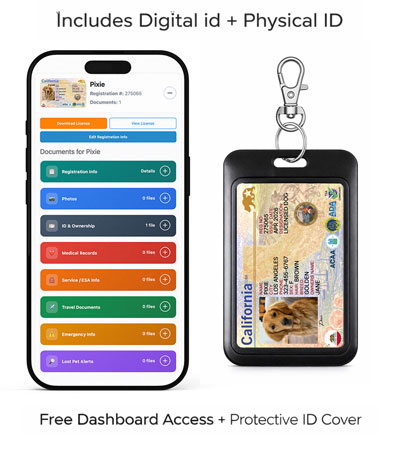
If you’re asking, “where do I register my dog in Hancock County, Iowa for my service dog or emotional support dog?” the first thing to know is that most “registration” questions involve two different systems: (1) local dog licensing/rabies tag rules (city or county), and (2) federal and state disability laws that define service dogs.
This page explains how a dog license in Hancock County, Iowa typically works, what rabies vaccination proof is commonly required, and how service dogs and emotional support animals fit into (or do not fit into) local licensing. It also lists official offices you can call to confirm exactly where to register a dog in Hancock County, Iowa based on where you live (city limits vs. rural addresses).
Where to Register or License Your Dog in Hancock County, Iowa
Because licensing and rabies enforcement can be handled locally, the offices below are good official starting points for animal control dog license Hancock County, Iowa questions and for confirming the exact steps for your address. Contact the office that matches your location (city vs. rural) and ask whether they issue licenses/tags directly, require an application, or refer you to another local authority.
Example Official Offices (Hancock County & City)
| Office | Address | Phone | Hours | |
|---|---|---|---|---|
| Hancock County Sheriff / Communications (Non-Emergency Dispatch) |
875 State St. Garner, IA 50438 |
641-923-2621 | Not publicly listed on the county contact page | Not listed (call to confirm) |
| Hancock County Courthouse (General County Offices Location) |
855 State St. Garner, IA 50438 |
Varies by department | Not listed (varies by department) | Mon–Fri 8:00 a.m. – 4:00 p.m. (department hours may vary) |
| City of Garner – City Hall |
135 W 5th Street Garner, IA 50438 |
641-923-2588 | admin@garneriowa.org | Mon–Fri 8:00 a.m. – 4:30 p.m. |
| City of Britt – City / Township Contact (City Hall main line) | Street address, email, and hours not available from the official state contacts list | 641-843-4433 | Not listed | Not listed |
Tip: When you call, ask: “Do you issue dog licenses/rabies tags for my address, or should I work with a different city office?” If you’re asking about “registration” for a service dog or ESA, also ask: “Is a dog license required for all dogs, including service animals, in your jurisdiction?”
Quick Answer: Where to Start
- If you live in Garner: start with Garner City Hall (often the licensing point for residents inside city limits).
- If you live in Britt: start with the Britt City Hall main line (the state’s official contact directory lists the city phone).
- If you live outside city limits or you’re not sure: call Hancock County Sheriff/Dispatch (non-emergency) and ask who handles dog licensing and rabies enforcement where you live.
Overview of Dog Licensing in Hancock County, Iowa
What “registering your dog” usually means
In everyday terms, “registering” a dog typically means getting a local license (often a numbered tag) tied to your dog and your address. A dog license in Hancock County, Iowa helps local officials connect a found dog to its owner and supports rabies enforcement rules (especially after a bite or exposure report).
Local licensing is usually city-based
In Iowa, it’s common for licensing to be handled by the city where you live (through City Hall, City Clerk, or a similar office), while animal control enforcement and investigations may involve local law enforcement or contracted animal services. That’s why “where to register a dog in Hancock County, Iowa” depends on whether your address is inside an incorporated city (like Garner or Britt) or in an unincorporated/rural area of the county.
Rabies vaccination is a core requirement
Most jurisdictions that require licensing also require proof of a current rabies vaccination from a veterinarian. If your dog’s rabies vaccination is expired, you may be required to update it before you can obtain or renew a license/tag. Keep a copy of your rabies certificate in a safe place (paper or digital) because you may need it for licensing, boarding, grooming, or housing paperwork.
How Dog Licensing Works Locally in Hancock County, Iowa
Step 1: Identify your licensing jurisdiction (city vs. rural)
Start by identifying where you live:
- Inside city limits: licensing is often handled through City Hall/City Clerk.
- Outside city limits (rural/unincorporated): the responsible agency can vary. If you’re not sure who administers licensing or rabies enforcement, call the Hancock County Sheriff/Dispatch (non-emergency) and ask where to complete licensing for your address.
Step 2: Prepare your documents
When you contact the licensing office, be ready to provide:
- Rabies vaccination proof (certificate from your veterinarian, showing the vaccination date and expiration).
- Owner identification (name and contact info; some offices may request ID).
- Proof of residency (especially if you recently moved or if the city requires it).
- Payment for the licensing fee (fee amounts and accepted payment types vary by jurisdiction).
Step 3: Ask the right questions for your situation
To avoid delays, ask your local office:
- Is a license required for all dogs or only dogs over a certain age?
- What documentation is required for a new license vs. a renewal?
- Is there a deadline or renewal period (annual, multi-year, etc.)?
- Are there different fees for altered/spayed/neutered dogs?
- If my dog is a service dog, do you still require a local dog license/tag?
Service Dog Laws in Hancock County, Iowa
Service dog vs. dog license: they are not the same
A service dog is defined by its training to perform specific tasks for a person with a disability. That legal status comes from disability laws (not from buying a tag online, not from a registry certificate, and not from a vest). Separately, a local dog license (sometimes called “registration”) is a local identification and rabies-control system. In many places, service dogs must still follow neutral public health rules that apply to all dogs, such as rabies vaccination and licensing—unless a specific local rule provides an exemption.
What you can be asked in public places
In general, staff at public-facing businesses may be limited in what they can ask. A typical approach is that they may ask questions focused on whether the dog is required because of a disability and what work or tasks the dog has been trained to perform. They generally should not demand medical documentation or insist on seeing a “service dog registration card” as proof.
Local compliance still matters
Even when a dog is a legitimate service dog, it is still important to comply with local animal rules that apply to all dogs (like leash, vaccination, and potentially a local license). If you are unsure how the animal control dog license Hancock County, Iowa rules apply to service animals in your city, call your local City Hall or the Sheriff/Dispatch non-emergency number and ask specifically about service-dog licensing expectations.
Emotional Support Animal Rules in Hancock County, Iowa
An ESA is not a service dog
An emotional support animal (ESA) typically provides comfort by its presence, but it is not trained to perform specific disability-related tasks in the same way a service dog is. That difference matters because ESAs generally do not have the same public-access rights as service dogs. In many situations (restaurants, grocery stores, most public indoor spaces), an ESA may be treated as a pet under applicable rules.
Housing and local licensing are separate topics
Some people first learn about ESAs through housing-related requests. Even when an ESA is recognized for housing accommodation purposes, that does not automatically replace local requirements for rabies vaccination, leash rules, or a local dog license in Hancock County, Iowa. In other words: housing status and local licensing are different systems. If you’re asking where to register your dog because you need paperwork for housing, it’s still wise to contact the local licensing office for your address to see what they can provide (license/tag, receipt, or other proof of compliance).
Avoid confusing “online registration” with legal status
Many people search for a certificate or registry number when they really need a local license or proof of rabies vaccination. If you need something official for local compliance, start with the offices listed above rather than any third-party registry. When in doubt, ask your City Hall (or the Sheriff/Dispatch non-emergency line for rural addresses) what documentation they accept.